Talismanic Tunic

Talismanic Tunic, Ghana, ca. 1920-50
Accession Number 2021.32.3
Yale University Art Gallery
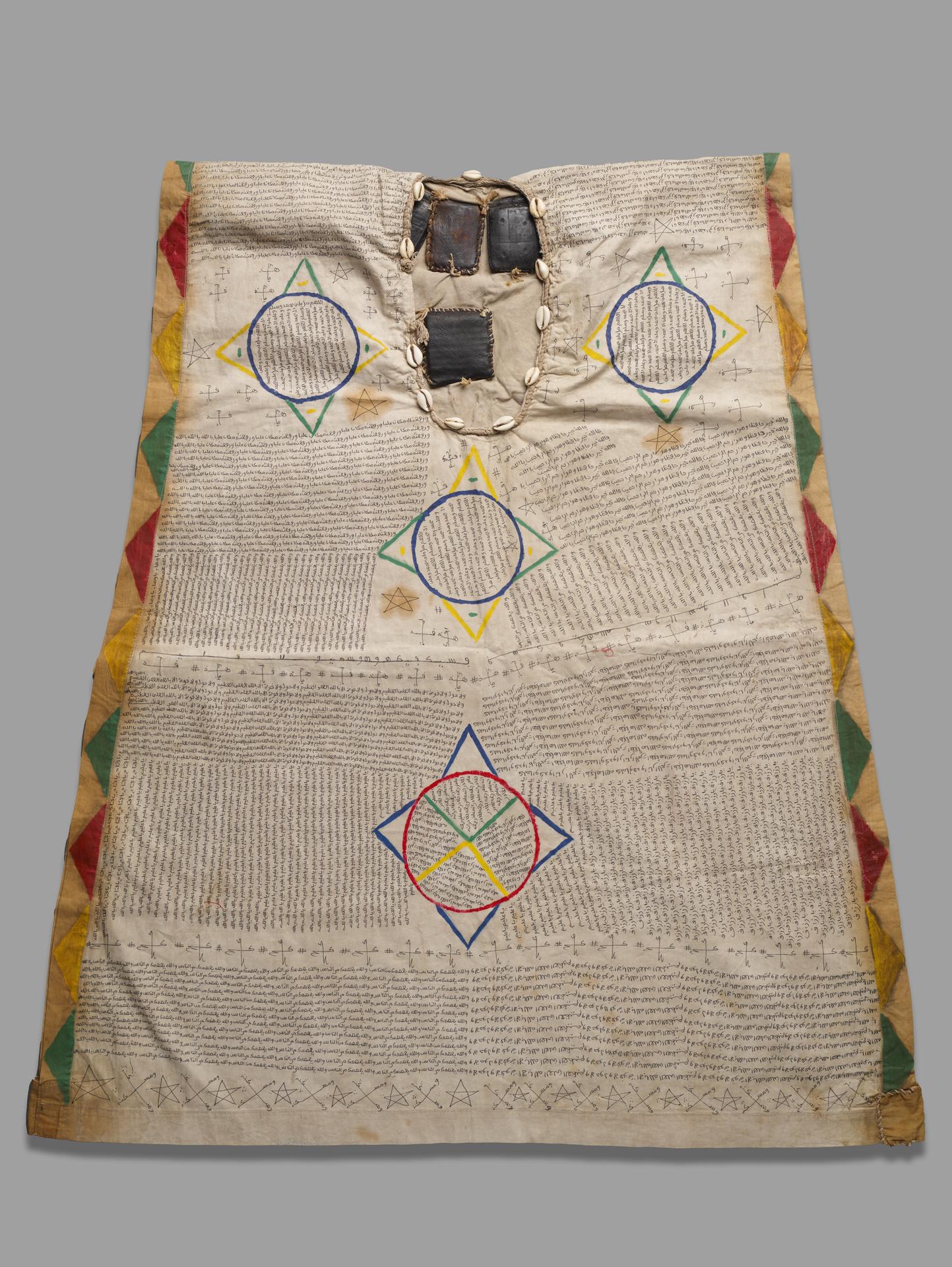
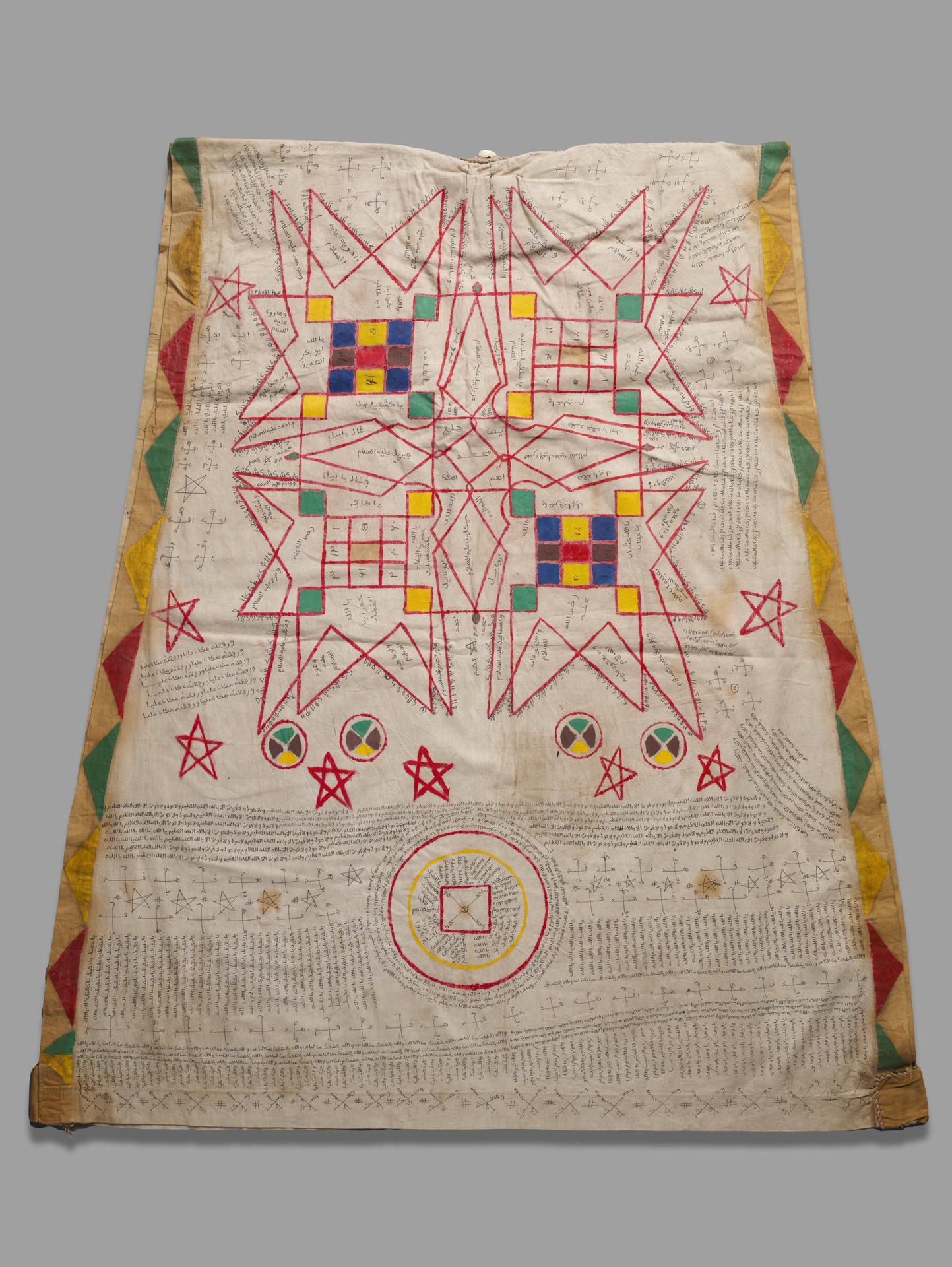
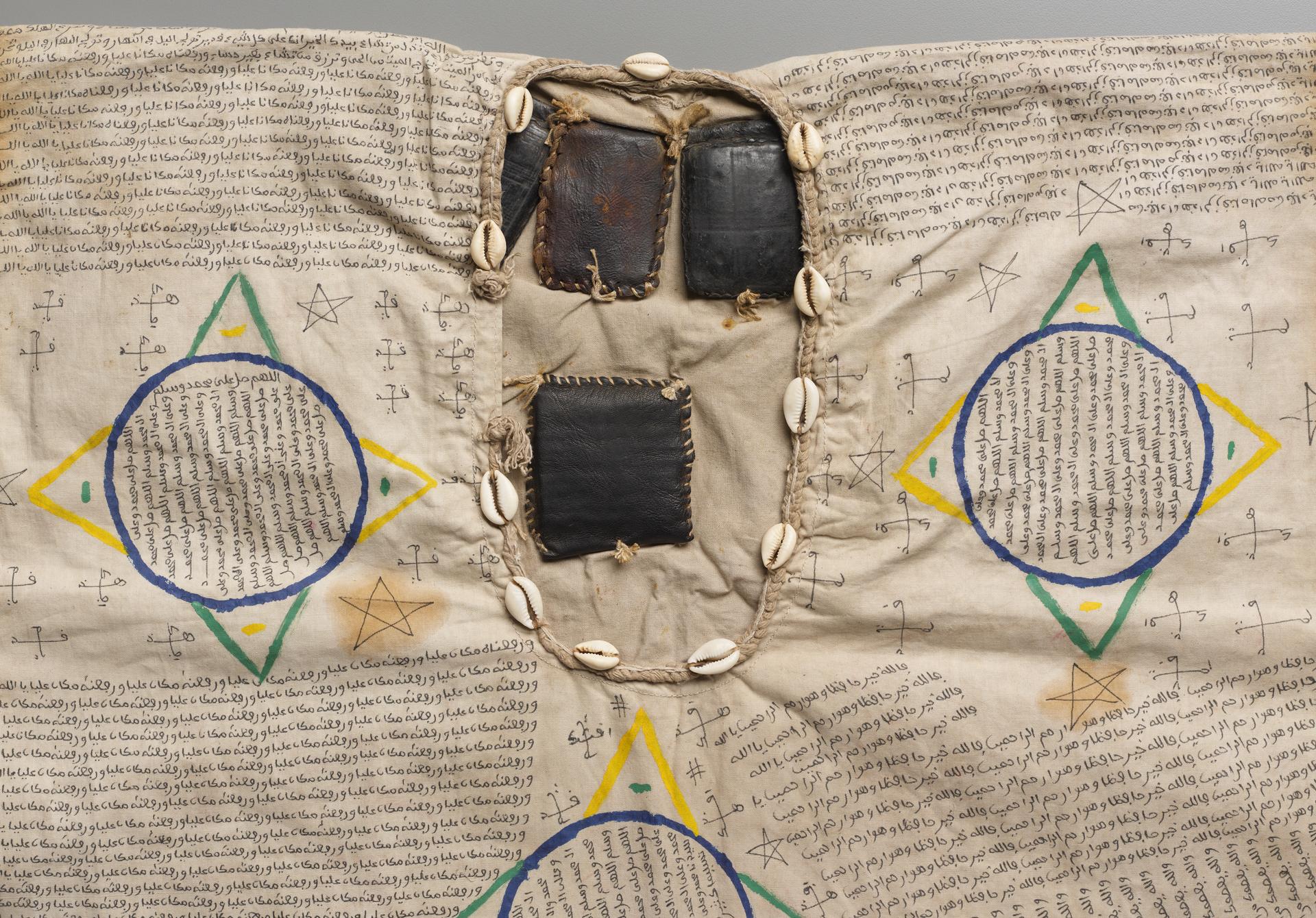
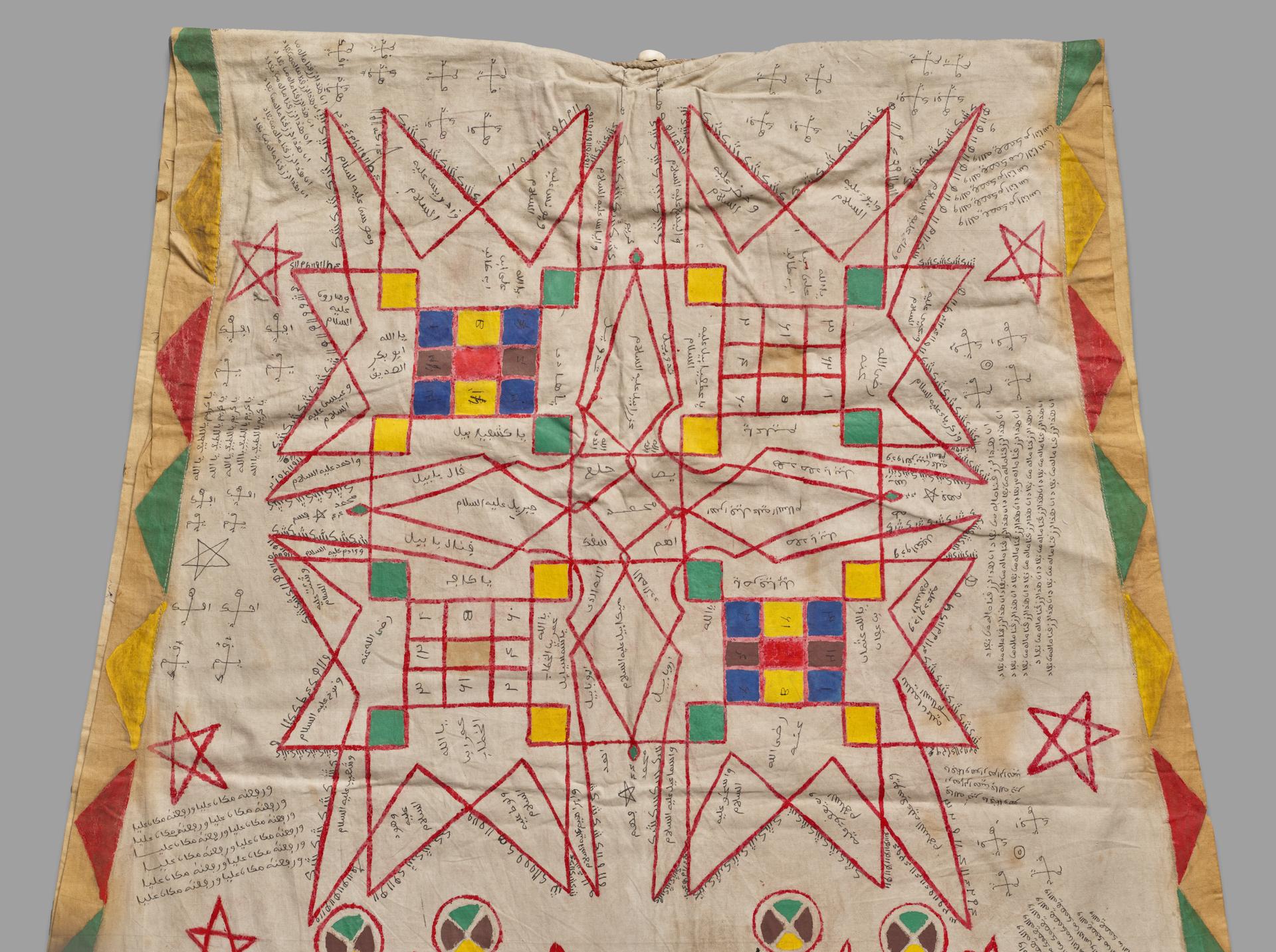
This talismanic shirt from Ghana dates to the first half of the twentieth century and entered Yale’s collection in 2021. Only upon closer examination does the sheer, painstaking scale of the work required to complete the shirt become apparent: its surface is composed of intricately inscribed and repeating excerpts from the Qur’an, common Islamic supplications, and amuletic motifs, in addition to so-called “magic squares” (awfāq) filled out with figures of numerological importance. The shirt itself is made of cotton and the Arabic script is composed with ink, but paint was also used to compose numerological grids and magic squares, in addition to hexagrams and various other shapes. Cowrie shells adorn the neck, and leather pouches, presumably containing additional amulets, are sewn into the interior of the shirt.
Like other talismans and amulets, recent scholarship has revealed that talismanic shirts were likely commissioned across the Islamic world for all kinds of protective purposes, be it to protect against illness, to curry favor with the powerful, to succeed in battle, or to hasten good fortune––in fact, one of the first descriptions of what we now call talismanic shirts appears in the writings of the authoritative medieval scholar of the occult, Ahmad al-Buni (d. 1225), who witnessed their use “to earn the affection of a person” in Ayyubid Egypt. One comes across them across social strata and throughout the centuries. We can assume they were used in battle because of an oft-quoted letter from the 1530s in which Hürrem Sultan pleaded with her husband, the Ottoman Sultan Süleyman, “to wear the shirt she had dispatched to the battlefield as it would ‘turn aside bullets’ and protect him from death.” But then there is Hassan Pasha (d.1572), who commissioned a talismanic shirt in the hopes that it would allow God to “grant him favor by placing love for him in the heart of Sultan Mustafa.” Then there is a magnificent Indian example at the V&A Museum from the 15-16th century which features the entirety of the Qur’an written all over it in breathtakingly minuscule script; its precise use is unknown to us, but it features extensive staining in the armpit regions, indicating that whatever its protective purpose may have been, it was put to good, well-worn use.
Focusing on a context far removed in space and time, a recent exhibition at the Institut du Monde Arabe in Paris was devoted to twentieth-century and contemporary talismanic shirts recovered by trash pickers from garbage heaps in West Africa, where “expensive talismanic shirts worn to win a local election or a football match are often discarded.” It is to the latter context that the Yale talismanic shirt belongs, though it is anyone’s guess as to why, for whom, and by whom the shirt was made. As the vibrant color palette and cowrie shells attest, regardless of the shirt’s intended purpose, or who its maker or intended wearer were, it is an unmistakable expression of a centuries-old practice among Muslims that has been adapted to local aesthetic sensibilities and spiritual needs.
Sources:
Anetshofer, Helga. “The Hero Dons a Talismanic Shirt for Battle: Magical Objects Aiding the Warrior in a Turkish Epic Romance.” Journal of Near Eastern Studies 77, no. 2 (2018): 175–93. https://doi.org/10.1086/699185.
Felek, Özgen. “Fears, Hopes, and Dreams: The Talismanic Shirts of Murād Iii.” Arabica 64, nos. 3–4 (2017): 647–72. https://doi.org/10.1163/15700585-12341454.
Fotheringham, Avalon. “A Warrior’s Magic Shirt • V&A Blog.” V&A Blog, June 17, 2015. https://www.vam.ac.uk/blog/fabric-of-india/guest-post-a-warriors-magic-….
Gruber, Christiane. “From Prayer to Protection: Amulets and Talismans in the Islamic World.” In Power and Protection: Islamic Art and the Supernatural. Ashmolean Museum, 2016.
Leoni, Francesca. “Sacred Words, Sacred Power: Qur’anic and Pious Phrases as Sources of Healing and Protection.” In Power and Protection: Islamic Art and the Supernatural. Ashmolean Museum, 2016.
Leoni, Francesca, Pierre Lory, and Christiane Gruber. Power and Protection: Islamic Art and the Supernatural. Edited by Francesca Leoni. With Farouk Yahya and Venetia Porter. Ashmolean Museum, 2016.
TROIS VÊTEMENTS TALISMANIQUES PROVENANT DU SÉNÉGAL (DÉCHARGE DE DAKAR-PIKINE). n.d.
“Tunic; Jibba | British Museum.” Accessed April 19, 2026. https://www.britishmuseum.org/collection/object/E_Af1940-23-1.
“Un Art Secret | Institut Du Monde Arabe.” Accessed April 18, 2026. https://www.imarabe.org/fr/agenda/expositions-musee/art-secret.
Look Closer at the Object


6