Ascetic in Meditation

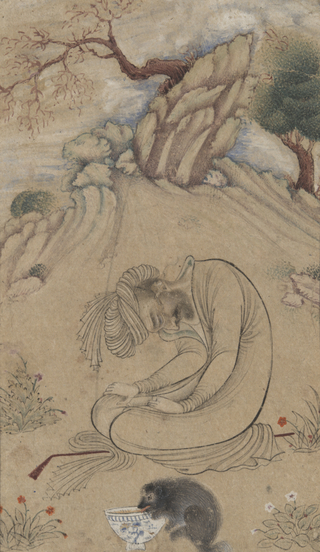
Ascetic in Meditation, attributed to Mu’in Musavvir (Persian, ca. 1610–1693), Iran, 17th century
Accession Number 2001.138.7
Yale University Art Gallery
This painting has been attributed to one of the most renowned painters of the Safavid dynasty (1501–1722), Muʿin Musawir (ca. 1610/1615–1693) of Isfahan. The painting depicts a wayfarer with bowed head kneels on the ground. His walking staff lies beneath him, and a blue-and-white porcelain bowl rests at his side. Blossoms cluster in the wild grasses of the countryside; beyond, white clouds rise above distant rocks and trees. He appears to be a mendicant monk on the road, pausing to rest. With both hands placed upon his knees, his neck bent forward onto his chest, brows furrowed, eyes closed, and lips tightly pressed, he must be exhausted from travel. One can almost hear the rhythm of his breathing in sleep beneath the drooping folds of his rounded turban. At the bottom of the composition, a small black dog lies prostrate over the porcelain bowl, licking the nectar it contains to the brim.
The drawing demonstrates a masterful command of lines, including –thick lines of the body, fine lines depict cloths, and shading lines as well as the dots and lines to demonstrate trees and rocks. Amid the spacious folds of drapery, this most finely wrought close-up of the head—combined with the unusual low, drooping profile—draws the viewer’s gaze to the center of the composition, inviting contemplation that drifts along with the sleeper’s inward repose. The landscape may act as psychological metaphor. The jagged rocks feel like obstacles. The distant peaks suggest aspiration. A heavy white sky opens to a narrow band of blue. The terrain becomes an exteriorization of inner discipline and struggle.
The painting participates in a broader trans-cultural moment, including the porcelain, pine motif, the fine texturing technique, and even the motif “lofty recluse beneath a tree’. At that time, between Safavid Iran and late Ming–early Qing China, what we see here is mature adaptation—what we might call Islamic Chinoiserie. With its plain linear style and light coloring, this work sweeps away the opulent gold-and-blue splendor of courtly taste. It is not an illustration of a fixed literary narrative, but more likely a private creation reflecting the painter’s personal state of mind. Unfortunately, the life of Musawir remains obscure, and the precise circumstances of this work’s creation are difficult to ascertain. The work invites us not simply to look at an ascetic—but to recognize how pictorial form itself can stage interiority.
Sources:
Rizvi, Kishwar, ed. Affect, Emotion, and Subjectivity in Early Modern Muslim Empires: New Studies in Ottoman, Safavid, and Mughal Art and Culture. Boston: Brill, 2018.
Farhad, Massumeh. “The Art of Muʿin Musavvir: A Mirror of His Times.” In Persian Masters: Five Centuries of Painting, ed. Sheila R. Canby. Bombay: Marg Publications, 1990, pp. 113–128.
Canby, Sheila R. “An Illustrated Šāh-nāma of 1650: Isfahan in the Service of Yazd.” Journal of the David Collection, Vol. 3, Copenhagen, 2010, pp. 54–113.