Double Leaves of a Quran in Kufic Script
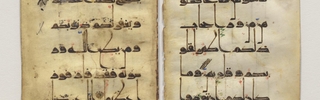

Double Leaves of a Quran in Kufic Script, Iran, 1037–1194
Accession Number 1951.51.53a-b
Yale University Art Gallery
Dating to the twelfth century in Iran, a double leaf of a Quran in Kufic script is a significant
artifact showcasing the evolution of Islamic calligraphy. Crafted from ink on deerskin, each page measures 14.3 by 10.9 centimeters. Although attributed to the Seljuk Dynasty, these pages bear a striking resemblance to Abbasid calligraphic works, suggesting a possible origin from that era.
The manuscript’s style and characteristics closely resemble Abbasid calligraphy, with thin strokes and colorful diacritical marks, aligning more with Abbasid conventions than Seljuk script. Furthermore, its layout with vertical pages and unique script variations deviates from typical Seljuk styles, reinforcing the hypothesis of Abbasid influence.
Ritually, the manuscript holds immense importance as a representation of divine order through
calligraphy. Calligraphers in the medieval Islamic world viewed the act of copying the words of
God as a sacred endeavor, transcending mere craftsmanship. This manuscript, with its intricate design and spiritual significance, embodies the devotional connection between written language and its divine message. It serves as a testament to the enduring ritual importance of the Quran, not only as a religious text but also as a medium for spiritual devotion and artistic expression.
Sources:
Farhad, Massumeh, et al. The Art of the Qurʼan: Treasures From the Museum of Turkish and Islamic Arts. Smithsonian Institution, 2016.
George, A. The Rise of Islamic Calligraphy. London: Saqi, 2010.